We own the whole RL stack
A frontier lab comes to us with a model to improve. We build the environments, benchmark it, train it, then benchmark it again to see whether it improved.
- Frontier labBrings a goal and a checkpoint
- RL environmentsExpert humans write tasks, engineers make them run
- BenchmarkExperts run it and record where the model fails
- Hired expertsWork the tasks: demonstrate, judge, review attempts
- RL trainerUpdates the weights
- Benchmark againSame sealed test, old model vs new
- Did it improve?Honest report back to the lab. If not, better tasks, reward or settings.
Where the checkpoint comes from
First proof
Shows the whole loop works, before asking a lab to trust us.
Lab engagement
The goal. Needs a contract and the lab's authorization.
Two groups of experts, kept apart
Training side
Sees development failures. Never sees the sealed test.
Benchmark side
Sees the sealed test. Never helps train.
Everything else exists to protect three things
The task is worth learning
A buyer cares about it and qualified people reviewed it.
The score is honest
A protected verifier judges the result and resists shortcuts.
The test is unseen
Reported gains come from tasks kept out of training.
Six parts, and each can be sold alone
- Customer projectsOutput: approved brief
- Expert platformOutput: reviewed tasks
- EnvironmentsOutput: runnable attempts
- VerificationOutput: score and evidence
- RL trainingOutput: checkpoints
- Data pipelineOutput: datasets, where rights allow
Follow one task through the loop, an invented example
- The lab's requestIts agent cites records it never opened. The lab brings a checkpoint and a budget.
- EnvironmentA training expert writes a research task over a small document set, and a second expert reviews it. An engineer wires up the search tool.
- BenchmarkThe starting model runs. Development results show the habit. Benchmark experts hold similar tasks the training side never sees.
- TrainingThe model attempts the task many times. The verifier checks each citation against the records actually opened, and the trainer updates the weights.
- Attempt reviewAn expert reads a sample and spots a shortcut: open every record, then cite at random. That becomes a verifier fix and a new round.
- Benchmark againThe trained model takes the sealed tasks under the same rules. Experts count which tasks moved from fail to pass, and from pass to fail.
- ReportThe lab gets the result either way, with regressions and costs included.
Invented to show the mechanics. No such run has happened, and this is not a chosen market.
What a customer engagement looks like
- BriefThe team names a behavior to improve and how the model can be used.
- SampleWe recruit authors and reviewers and produce a small sample. The customer reviews it before scale.
- BuildEngineers make approved tasks executable. A researcher runs the current model and reports where it fails.
- TrainWith the lab's authorization, we run the agreed experiment and compare the checkpoint to the original.
- DeliverA versioned manifest names tasks, environment, verifier, setup, tests, limits and a contact. If a grader changes later, publish a new version and say whether old scores still compare.
Own the specification, quality process, environment integration and customer relationship. Use existing software for identity, inference and training until cost, capability or contract limits block delivery.
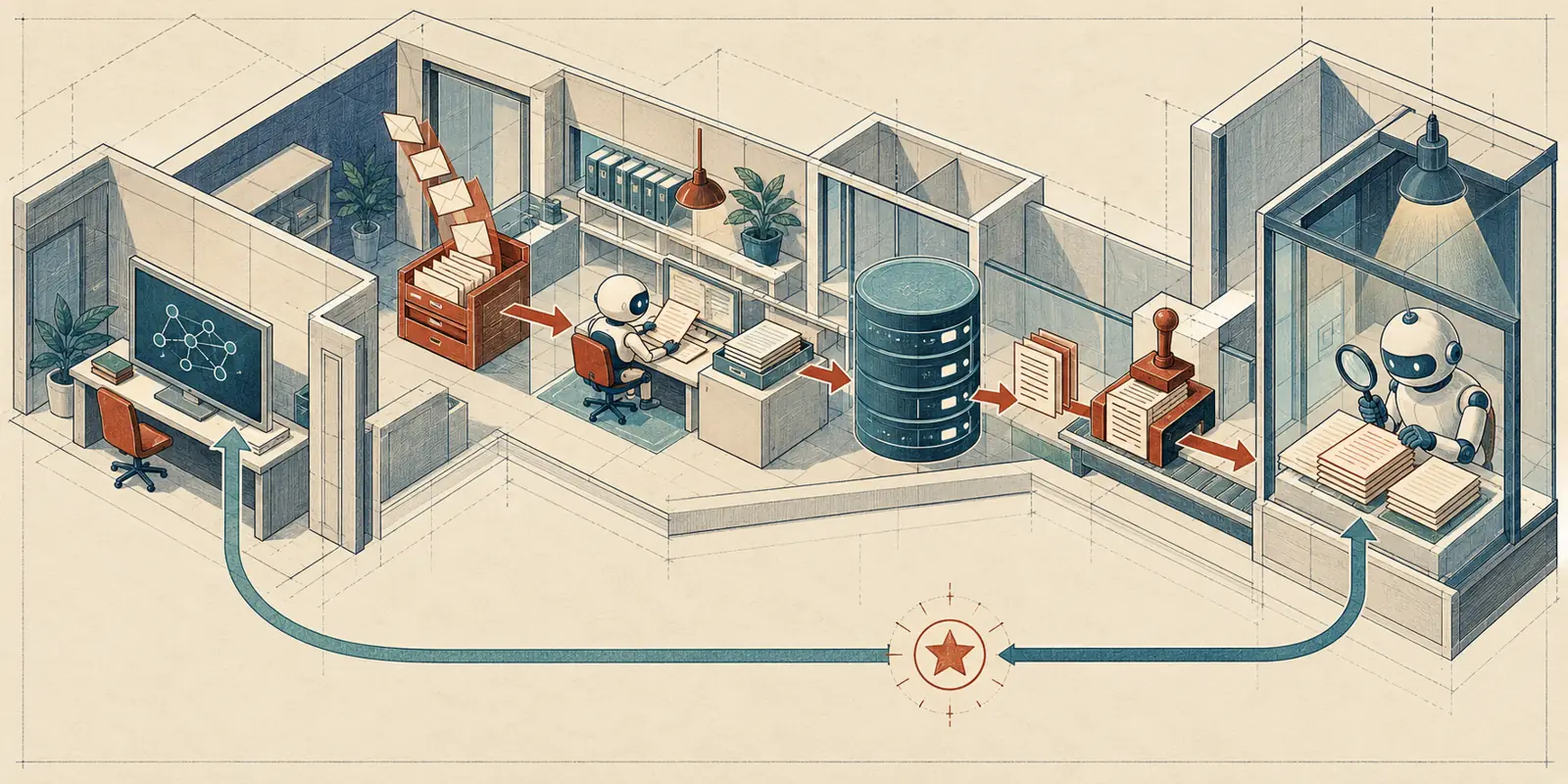
The environment gives feedback. The trainer changes the model.
How an attempt can end, and what is kept
A task outcome
Goes into the score
An operational error
Never becomes a zero reward
Kept for the trainer
A transcript alone is not enough
Measure, imitate or practise
Benchmark
Measures. Fixed tasks, a fixed model, a score.
Environment
Lets an agent act, see consequences and repeat.
Training platform
Adds scheduling, inference, scoring, optimizing and records.
Which service to propose first
GRPO, and what to inspect first
GRPO is one family of RL methods. It compares sampled attempts by relative reward. It is a starting option, not a universal answer.
Generate one episode by hand before running in parallel. That one check often finds mismatched tool schemas, missing state, or rewards that miss the requested behavior. Grader material must never appear in any trace the agent can see.
The idea has evidence. Our version has none yet.
Supports the idea
Warns about it
Four experiments that would make the evidence ours, none run yet
- 1Neutral testBaseline tasks come from people who never saw the agent's prompt.
- 2Human vs generatedCompare expert tasks with generated variants, and look for gaps and shortcuts.
- 3Cross-family transferTrain on one family, then test on another or a partner's set.
- 4Reward vs cheatingWatch whether grader defects and unsafe acts climb as reward climbs.
Who publicly describes what
| Company | Experts | Environments | Evaluation | Training | Borrow from them |
|---|---|---|---|---|---|
| Handshake AI | yes | no | partly | no | Briefs, qualification, paid queues, support |
| Snorkel | yes | yes | partly | no | Experts review grading with engineers |
| Turing | yes | yes | no | no | Delivery formats and quality controls |
| Surge AI | yes | yes | yes | yes | Tasks plus a controlled run and fair test |
| Mercor | yes | partly | yes | partly | Link contributor work to a written recipe |
| Prime Intellect | no | yes | yes | yes | A maintained trainer, versioned interface |
| Polymath | no | yes | no | no | Depth for long-horizon agents |
| Scale | partly | partly | partly | partly | Evidence standards |
| Our plan | partly | partly | partly | partly | Untested. No customer has chosen this mix. |
A moat is still a hypothesis
A moat is why customers keep choosing you after others can copy the software. Right now we have guesses.
| Candidate | Build it by | Test it by |
|---|---|---|
| Expert supply | Paying and keeping proven reviewers | Qualified availability, retention, review quality |
| Task and verifier quality | Versioned solutions, exploit tests, review records | Defects after release, false passes in audits |
| Customer integration | Supporting the buyer's interface and security | Setup time, repeat use |
| Data rights | Negotiating reuse for permitted artifacts | Usable artifacts by license, not files stored |
| Training evidence | Controlled comparisons on independent tasks | Lift, uncertainty, costs and failures |
How the moat could build, and how it can break
- 1First engagementRecord each task, correction, grader defect and integration issue.
- 2Second engagementReuse the process where rights permit. Measure what got faster.
- 3Repeat purchaseAsk for a new family or harder cases. Record why they stay or stop.
- 4Dated evidenceQuality, delivery time and held-out results.
A task board or a wrapper around an open-source trainer will not defend anything. An exclusive contract funds early work but blocks reuse, so price it that way.
Each user gets a different view of the same project
First release
Later
The contributor journey
- 1ApplySkills, language, location. Check credentials only if the project needs them.
- 2QualifyA small paid task with a known rubric, and a way to appeal.
- 3WorkTime, rate, permitted tools and rules are shown before starting.
- 4ReviewStatus, comments, revision and dispute routes.
- 5PayAn auditable record of approved earnings and payment.
One task, one path
What a task holds
The agent sees
Hidden from the agent
Kept with the record
An example task
| Part | Example, illustrative only |
|---|---|
| Goal | Use search and document tools to answer a question and cite the supporting records. |
| Start | A versioned document set, a search tool, and an action limit. |
| Success | Required facts with references. States when information is missing. |
| Critical failure | Cites a record it never opened, or reveals a restricted document. |
| Evidence | Reference solution, source records, expected checks, acceptable alternatives. |
Start with two kinds of work, add others when a project needs them
Task authoring
Problem and expected outcome. Checked for correctness and solvability. In the first release.
Demonstration
A valid action sequence. Checked for evidence and policy. Reported as its own training stage.
Rubric writing
Success and critical failure criteria. Checked for coverage.
Pairwise comparison
A choice between two outputs, with a reason. Checked for agreement.
Attempt review
A diagnosis of a model attempt. Checked against the trace. In the first release.
Environment testing
A bug or exploit attempt. Checked for reproducibility.
Review each item, and measure whether reviewers agree
When reviewers disagree
Agreement is evidence, not proof of correctness. Keep disagreements on record. Review every item in small batches, then agree a risk-based sample with the customer. Avoid one opaque score per person.
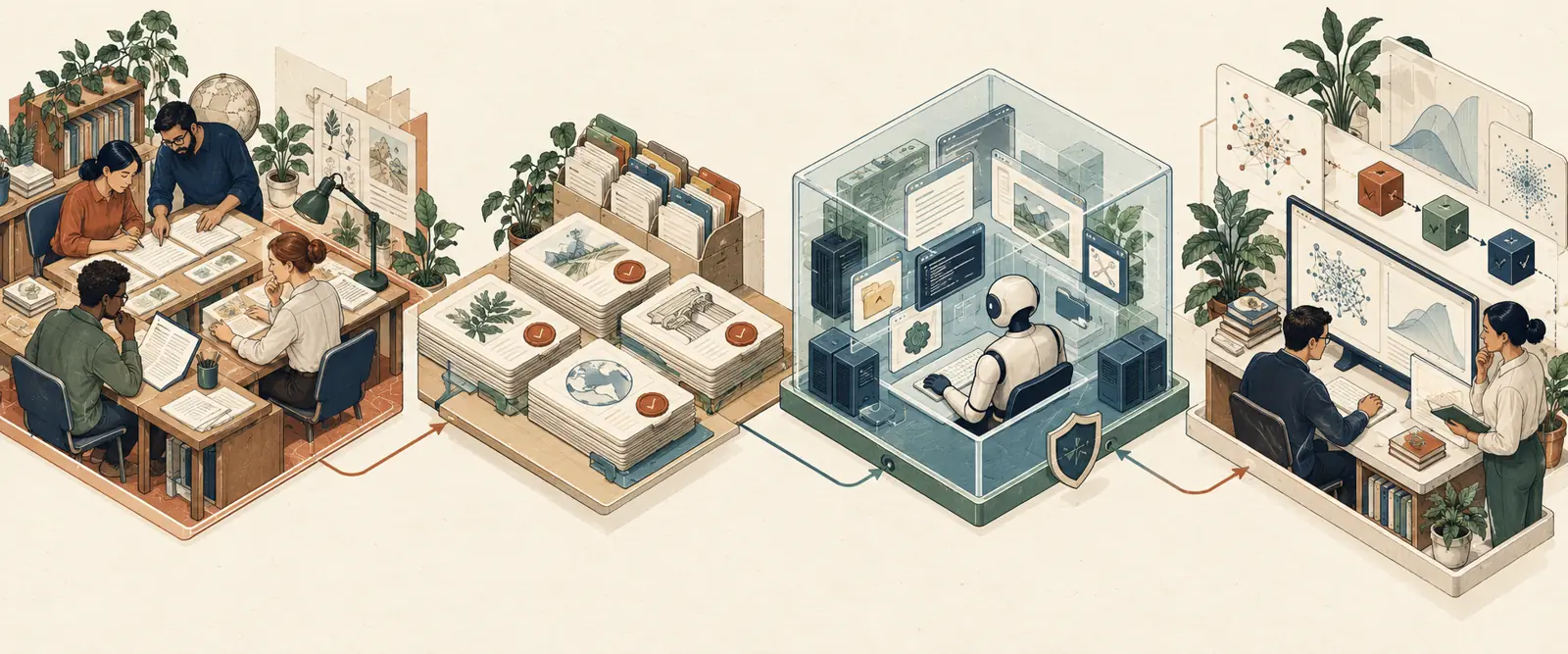
A world to act in, and a judge the agent cannot reach
Pick the type after a buyer names the capability
Tool environment
Structured actions. Simplest to run and inspect.
Browser or desktop
Visual interaction, more resources, rendering and timing failures.
Coding
Runs code, so it needs careful isolation.
A task can be one step, many steps, or stateful across steps. Use the simplest shape that tests the skill, since many tasks need no browser or simulated company.
Build one from a written spec
- 1WriteGoal, actions, observations, outcome
- 2SeedSmall start state, synthetic or authorized
- 3ImplementTools and permission checks
- 4CheckOutcome and forbidden actions
- 5AttackRun valid and invalid attempts
- 6PackageWith tests and a version manifest
Test the grader like an adversary
| Attempt | Expected | If it does not, the grader |
|---|---|---|
| Correct reference solution | Pass | may reject valid work |
| Alternative valid solution | Pass | is too rigid |
| Missing required step | Fail or partial | rewards incomplete work |
| Correct result, forbidden action | Critical failure | ignores safety rules |
| Agent claims success in its output | No credit | trusts the report, not the result |
Code checks
When the desired state can be stated exactly.
Model judge
For scale. Calibrate against experts first.
Human review
For nuance, and to audit samples.
What the research adds
OpenEnv documents reset, step and state interfaces. Prime Intellect's verifiers is another approach. NeMo Gym separates tools and state from verification. LangChain separates writing a task from building it. Test a real integration before committing to any of them.
Keep failing examples as regression tests. An exploit test covers only the shortcut it tries, so keep reviewing high-reward attempts during training. Before running untrusted model-generated code, choose a stronger isolation boundary and restrict network and host access.
Start with an open model and a proven trainer
- Run configModel, split, reward, algorithm, budget, stop rules
- Rollout workersAttempts with tokens and log probabilities
- TrainerTakes scored samples, saves checkpoints
- EvaluationFixed development and held-out tasks
- Run historyCode, data, costs, metrics, decisions
The contract says where weights live and who runs the job
| Model | Weights live | Trainer run by | Our role |
|---|---|---|---|
| Lab-operated | Lab's system | Lab | Environment, scoring, integration, support |
| Lab or customer account | Their account | Us, through a narrow role they can revoke | Our main path for labs. See the design. |
| Our infrastructure | With us, by explicit authorization | Us | Train and return agreed artifacts |
| Provider tuning | API provider | Provider | Use the permitted workflow and limits |
Six questions to settle before any pilot
- Who operates the trainer?The lab, or us by authorization.
- Where do model and data stay?Lab environment, dedicated cloud account or our infrastructure.
- Which interface?Environment API, runtime, throughput, security questionnaire and data rules.
- Who supplies what?GPUs, inference, weights and the final evaluation set.
- Who sees and owns what?Trajectories, checkpoints, adapters and derived datasets.
- What ends the engagement?The evidence and acceptance criteria.
Proving an improvement
What a gain would mean
- Training reward roseCould be progress, could be an exploited verifier.
- Gain on held-out simulator tasksSupports improvement on that task distribution.
- Gain on independently written tasksStronger evidence of transfer.
- Gain on customer-provided tasksStrongest here, and still no guarantee for every deployment.
Report every time
Do not tune on the final test. Report it when simulator results and independent results disagree. A task removed after seeing results needs a written reason. Save the analysis plan and raw results so another researcher can reproduce it.
Prove the whole path once, without automating it
- Set upAn operator creates a project, reserves compute, writes instructions and invites people.
- AuthorA contributor drafts and submits a task with evidence.
- ReviewAn independent reviewer accepts it or asks for changes.
- ReleaseAccepted tasks ship as a versioned package with environment and verifier.
- BenchmarkRun the starting model on development and sealed tasks, and save the result. Training cannot be approved without it.
- TrainRL on a licensed open-weight model saves a checkpoint with updated weights. Paid experts review sampled attempts, and their findings feed the next round.
- Benchmark againThe trained model runs on the same sealed tasks under the same rules. Benchmark experts sign off the report.
Scope
Build now
Do by hand
Name an owner and keep records
Build later
Needs proven demand
What each feature must prove
| Feature | Proof it works |
|---|---|
| Project membership | A user cannot open another project's tasks. |
| Task editor | A refresh keeps the draft and the submitted version stays unchanged. |
| Independent review | The author cannot approve their own work. |
| Release | The export holds only selected approved tasks and their version IDs. |
| Environment run | Same fixture and seed reproduce the start. Worker failures show as infrastructure errors. |
| Verifier | Known valid, invalid and exploit attempts get the expected result. |
| RL trainer | Logs show optimizer updates and a checked change to trainable weights or adapters. |
| Report | A reviewer can trace a score back to its attempt and run version. |
If the schedule slips, cut in this order
A 12-week plan, to organize work and not to promise dates
Each step needs the one before it. The task spec comes before the environment, grader tests come before the reward is used, and the split is fixed before a checkpoint is chosen. If training is not ready by week 9, fix the blocker and replan. Do not spend more on training to make up for weak tasks.
The first 10 working days, and the two-weekly review
- Write the thesisOne page, with its assumptions listed.
- List peopleLab buyers, agent builders, contributors and reviewers.
- Ask buyersCapability, current evaluation, accepted interface, how pilots get approved.
- Ask contributorsQualifications, instructions, pay and feedback.
- Write one real specFrom one real requirement, without private data you may not use.
- Agree the basicsOne task schema, one rubric, one environment contract.
Sell a defined result, and record every right
Choose the first task with five questions
- 1ReachCan we reach a decision-maker and a technical champion?
- 2ExpertsCan qualified people write and review the tasks?
- 3CheckCan we check outcomes without relying only on opinion?
- 4AccessCan we get the data and permissions?
- 5BudgetCan we build and evaluate it with what we have?
How much a buyer's reaction is worth
- A complimentUseful feedback, not a signal of demand.
- Gaps named on a sample task and graderA technical owner is engaging.
- An engineer agrees to test the environmentA concrete next step.
- A written pilot scope with owner and budgetNow it is a real opportunity.
- A signed agreement and paymentThe only thing that counts as revenue.
Questions to ask a lab
- PainWhich capability is hard to improve today?
- FormatWhat does your task or environment package look like?
- FitWhat makes a task useful for your training mix?
- TrustHow do you verify tasks and stop reward exploits?
- OperatorWould you run our environment, or want us to run training?
- RulesWhat are your rights, security, concurrency and acceptance needs?
- BudgetWho owns the budget, and what makes a pilot worth paying for?
Pricing a pilot
- Expert work $2,000
- Engineering $4,800
- Infrastructure $400
- Left before overhead $4,800
An illustrative $12,000 pilot leaves 40% direct margin. These numbers show the sum. They are not market prices.
What the statement of work covers
| Part | Says |
|---|---|
| Problem | The capability to evaluate or improve. |
| Inputs | Experts, data, model access, interface and contacts. |
| Deliverables | Task release, environment, tests, baseline, checkpoint and held-out comparison. |
| Acceptance | Reproducible setup, documented quality, completed comparison. |
| Commercial | Fees, compute allowance, support, ownership and reuse. |
| Decision date | When the customer chooses to expand, revise or stop. |
Estimate from a small paid sample. Count authoring, review, adjudication, rework, project management, payment processing and founder time. If unsure, price a smaller discovery phase.
Permissions recorded today decide the future data business
- CollectAuthorized source and purpose
- ReviewQuality and sensitive content
- VersionLineage, license, retention
- UseOnly in permitted projects
| Artifact | The ledger must answer |
|---|---|
| Customer documents | Who supplied them? May contributors view, change or keep them? |
| Expert submissions | Who owns the work? May it train models or serve others? |
| Agent trajectories | Do provider terms and customer agreements allow storage and reuse? |
| Graders and environments | Exclusive, licensed, or reusable? |
| Checkpoints and adapters | Who controls access, retention, delivery and deletion? |
Security minimums
A container alone is not a full security boundary. Use synthetic data for prototypes. Get legal and security advice before accepting sensitive customer data.
Grow when the work requires it
- 1PrototypeInvited group, one environment, one full open-weight RL run
- 2Paid pilotsSame workflow, real requirements, repeated
- 3Customer trainingOn an authorized checkpoint or their environment
- 4Broader platformMore task types, matching, integrations
- 5Data productsOnly what agreements permit
| Owner | Responsible for |
|---|---|
| Founder or customer lead | Interviews, pilot scope, contracts, customer decisions |
| Platform engineer | Access, authoring, review workflow, release records |
| Environment engineer | Runtime, tools, reset, verifier, integration tests |
| Research or ML lead | Evaluation design, baseline, training, analysis |
| Contributor operations | Recruiting, instructions, assignment, review, payment records |
| Domain reviewers | Paid independent judgment on tasks and hard outcomes |
One person may hold several roles, but every job needs an owner. Hire against a measured bottleneck, such as a queue of tasks awaiting review. Bring in legal, tax and security specialists before making promises that depend on them.
What to show investors
Show
Never
- Introduction
- Technical discussion
- Sample review
- Written pilot scope
- Signed agreement
Five questions that could change the plan
- Will labs pay for the combined service?
- Can we recruit and keep the right experts?
- Do verified tasks improve held-out performance?
- Can we access weights or a supported training product?
- Do contracts permit reusable data?If the evidence is negative, narrow the offer or change the customer before spending more.
Build the budget from people, expert payments, infrastructure, GPU runs, legal, security and operations. Model cash by month, net of customer gross profit, with a reserve for delays. Keep a data room ready with formation papers, contracts, rights records, assumptions and the demo. Tie each major cost to a milestone and say what happens if an experiment fails. Y Combinator and Sequoia offer frameworks, not legal, tax or investment advice.
Four steps, then read the critique
- 1Describe itOne page on the business and its first deliverable
- 2Ask buyersTasks, interfaces and training access they need
- 3Ask expertsQualifications, workflow and pay
- 4Pick and buildOne task family with a customer, then the full path
Words used on this site
| Term | Meaning |
|---|---|
| Task | Work the agent attempts. |
| Environment | The world and tools it uses. |
| Rollout | One attempt. |
| Verifier | A check that scores the attempt. |
| RL | Training that uses feedback to update behavior. |
| Held-out test | Tasks reserved for evaluation, never training. |
Documents to create from real conversations
Suggested reading: Handshake for operations, OpenEnv and verifiers for the task interface, TRL for what a trainer needs, CoreCraft and the evaluation guide for experiment design, then the reward-hacking and security sources before touching untrusted agents or customer data.
All sources, checked 2 November 2026
- Handshake AI, introduction
- Handshake AI, lab offering
- Handshake AI, contributor experience
- Scale Labs, RL with verifiable feedback
- Surge AI, CoreCraft paper
- Surge AI, enterprise offering
- Surge AI, post-training runs
- Snorkel, expert-built environments
- Turing, RL environments
- Polymath, YC profile
- Mercor and SkyRL, RL training guide
- Mercor, research
- Prime Intellect, platform overview
- Prime Intellect, prime-rl
- Prime Intellect, verifiers
- OpenEnv, environment interface
- OpenEnv, training guide
- Hugging Face, GRPO trainer
- Hugging Face, OpenEnv integration
- veRL, distributed RL training
- vLLM, inference engine
- LangChain, building environments and tasks
- NVIDIA, NeMo Gym tutorials
- Sierra Research, tau²-bench
- Anthropic, agent evaluation guide
- Hardening agent benchmarks
- Anthropic, a misaligned reward seeker
- DeepSeekMath, GRPO
- OpenAI, reinforcement fine-tuning
- Docker, security
- gVisor, architecture
- NIST, de-identification
- Y Combinator, seed fundraising
- Sequoia, writing a business plan
Company pages describe their own products and papers describe specific experiments. Research used Exa search plus original papers, official documentation and company pages.